




One of the most common concerns patients have before committing to dental treatment is not knowing what the end result will actually look like.
Spending time and money on a treatment plan that exists only in your imagination is understandably daunting. What if the result isn’t what you pictured? What if you’re halfway through your treatment and realize it’s heading in a direction you didn’t expect?
In this article, we’ll cover how modern dental technology allows you to see a realistic preview of your finished smile before anything has been changed, how that preview is created, how accurate it is, and what to do if it doesn’t match your expectations.
The Smile Design Consultation
Before any scanning, imaging, or treatment planning takes place, the consultation is where everything begins. This is the appointment where you get to communicate exactly what you want, ask questions, and make sure your expectations align with what’s actually achievable for your specific teeth, bone structure, and facial features.
This is the time to bring reference photos of smiles you find appealing. Visual references remove ambiguity and give the dentist something concrete to work from.
This is also the right moment to raise any concerns about your current smile, whether that’s the amount of gum that shows when you smile, the size or shape of your teeth, or the color you’re hoping to achieve. If something bothers you about your smile, this is the appointment to discuss it.
How the Preview Is Built
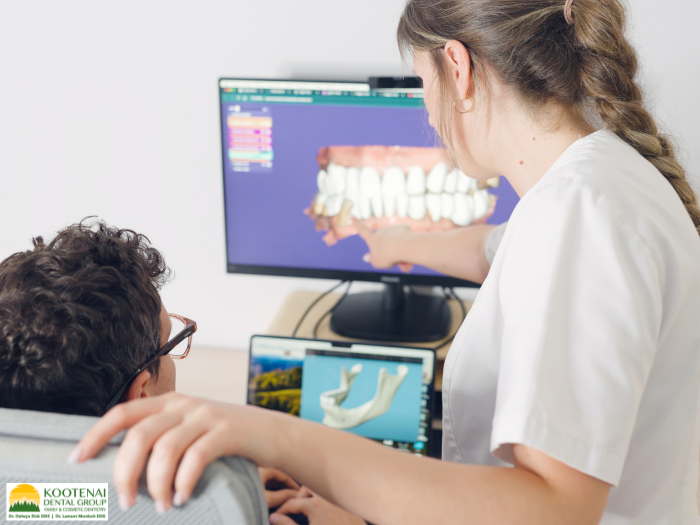
Most modern dental practices now use digital technology to generate a realistic simulation of a patient’s finished smile. It’s not a generic smile placed over a photo. It’s built from a detailed scan of your actual mouth, making it specific to your teeth, your bite, and your facial anatomy.
For cases involving dental implants, three-dimensional imaging plays an important role. Cone beam computed tomography, or CBCT, is a specialized type of X-ray that captures a complete 3D model of the jaw, teeth, sinuses, and nerves that allows you to see exactly what your jawbone structure looks like and how the implants will be positioned within it. Dentists use this scan to plan implant placement with a high degree of precision.
What the Preview Actually Shows You
A smile preview provides a full visual breakdown of what your treatment will accomplish, covering both the obvious changes and the more subtle ones that make a significant difference in how your smile looks overall.
When combined with digital smile design software, CBCT creates a complete picture of both the implant placement and what the finished smile will look like above it.
Depending on your treatment plan, the preview can show:
- Tooth alignment: Crooked teeth straightened, spacing corrected, and midlines centered.
- Bite correction: Overbites, underbites, and crossbites are visually resolved.
- Gum display: How much gum will be visible when you smile.
- Smile arc: The curve of your teeth adjusted to align naturally with your lower lip.
- Tooth proportions: Whether any teeth may benefit from reshaping or bonding alongside the main treatment.
- Bone density: How much bone is available and whether bone grafting is needed before implant placement.
- Implant placement: You can see exactly where each implant post will go and how deep it will sit.
- Spacing and alignment: How much space exists between your remaining teeth, and whether the new implant crowns will fit naturally.
- Gum line predictions: Advanced software can simulate how the gum tissue will heal around the implants.
- Bite relationship: The scan shows how your upper and lower teeth come together to align properly.
Many software systems show not just the final result but every stage of treatment from start to finish, so you can see exactly how your smile will progress along the way.
The preview can be viewed from the front, the side, and multiple angles, giving you a complete picture of what the finished result will look like.
How Accurate Are These Previews?
Smile previews are highly accurate, but they are predictions rather than guarantees. The software is built on established dental principles and data from a large number of real cases, and for the vast majority of patients, the finished smile closely matches what was shown at the start.
That said, teeth are part of a living system. Bone density, root shape, and individual healing patterns can all influence how teeth move and how gum tissue responds, and while the software accounts for general averages, every patient is different.
Minor differences between the preview and the final result are normal and don’t mean anything has gone wrong. If adjustments are needed along the way, an updated preview can be generated so you always have a clear picture of where treatment is headed.
Temporary Restorations
For patients undergoing implant placement, temporary restorations, also called provisionals, offer the most accurate preview of the final result. These are realistic, functional teeth that attach to your implants or remaining natural teeth during the healing phase. They’re designed to closely replicate the size, shape, and color of your final crowns, and you’ll wear them while your gums heal and the implants integrate with the bone.
Wearing temporary restorations gives you information that no digital simulation can fully replicate. You’ll notice whether the tooth length feels right when you speak, whether the color blends naturally with your surrounding teeth in different lighting throughout the day, and whether the bite feels comfortable and balanced. These are things that only become apparent when the teeth are in your mouth.
The temporary phase is also your opportunity to request changes before the permanent crowns are made. If something feels off, your dentist can make the necessary adjustments and incorporate them into the design of the permanent crown.
It’s worth noting that not every implant case includes a temporary phase. Whether provisionals are part of your treatment plan depends on factors such as bone quality, implant stability, and bite forces, among other things.
At Kootenai Dental Group in Coeur d’Alene, ID, Dr. Delwyn Dick, DDS, and our team of specialists will discuss the best approach for you during your consultation.
Why Seeing Your Results First Makes a Difference
Seeing the expected outcome before starting treatment gives you something concrete to base your decision on, rather than committing to a plan based purely on a verbal description.
If the preview doesn’t reflect what you were hoping for, it’s far better to address this during the consultation than halfway through treatment. At that point, your dentist can explore whether your goals can be adjusted or whether a different approach might get closer to your desired outcome.
In some cases, expectations may need to be shaped around what’s actually achievable with your teeth and anatomy, and the preview is what gives both you and the dentist a clear picture of what is and isn’t possible.
What to Do if You Don’t Like the Preview
Feeling uncertain after seeing the preview is completely understandable, and it’s far better to raise those concerns during the consultation than to start any treatment with doubts in the back of your mind.
Sometimes there’s a clinical reason behind certain decisions in the treatment plan that isn’t immediately obvious. For instance, a tooth that doesn’t appear to move as much as you expected might be limited by its root position or the surrounding bone.
Where adjustments are possible, the plan can be modified and a new preview generated so you can see the difference. Whether you want a wider smile, less gum showing, or different tooth proportions, many of these requests can be worked into your treatment. Others may be beyond what orthodontics alone can achieve, in which case options like cosmetic bonding or veneers can be looked at as part of a broader treatment plan.
Bottom Line
Thanks to modern dental technology, you no longer have to commit to a dental treatment plan based purely on a verbal description or a generic before-and-after photo. Between digital smile design, 3D imaging, and temporary restorations, there are multiple points throughout the process where you can see, assess, and give feedback on your results before anything becomes permanent.
For patients, being able to see the expected outcome before treatment begins makes a real difference. It removes the uncertainty, sets clear expectations, and gives you the confidence that the smile you’ve always dreamed of is within reach.
With nearly 30 years of experience in cosmetic and implant dentistry, Dr. Delwyn Dick, DDS, has the expertise to guide you through every stage of this process, making sure the treatment plan you commit to is one you feel confident about.
Call 208-762-8750 today to schedule your free consultation!!